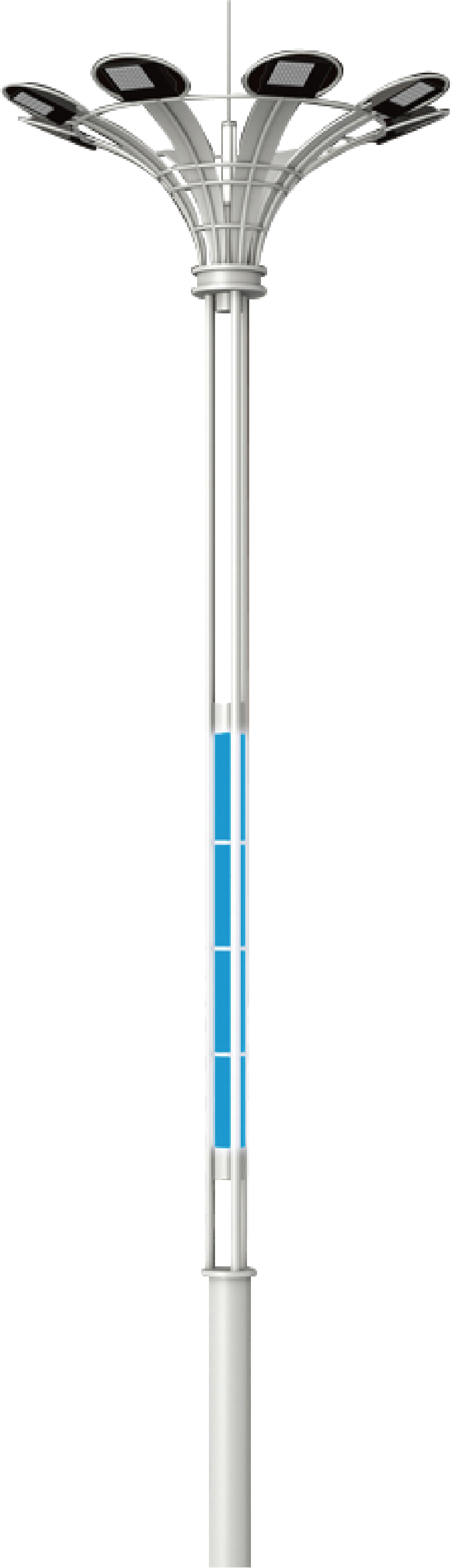
Modular LED arrays are leading the charge. Instead of replacing an entire fixture when a driver fails or a diode burns out, these new high mast light systems allow individual modules to be swapped in minutes from ground level using integrated lowering mechanisms. This cuts maintenance costs dramatically and reduces downtime—critical for ports and distribution centers that operate around the clock. But the real breakthrough is optical control. Modern arrays feature asymmetric and Type V distribution patterns that put light exactly where it's needed, eliminating the wasted upward scatter that creates skyglow.
Circular lighting design complements this by rethinking ring configurations. Traditional setups used evenly spaced fixtures around the pole head, creating a uniform but often harsh circle of light. New designs stagger the vertical angles of individual modules, aiming some downward for near-field coverage and others slightly outward for perimeter reach. The result is a gradient effect that reduces harsh shadows and minimizes glare for drivers and pedestrians entering the lit area.
This evolution ties directly into customized pole solution engineering. Standard off-the-shelf poles rarely accommodate the specific terrain, wind loads, and coverage requirements of unique sites. Today's manufacturers are offering tailored heights, wall thicknesses, and base plate configurations matched to soil conditions and seismic zones. Some even integrate internal cable management to protect wiring from tampering and weather—a detail that extends service life significantly.
For off-grid or temporary installations, pairing these systems with solar street light technology has proven a practical alternative. Solar street light modules mounted on separate low-level poles can handle perimeter or emergency illumination, while the high mast handles primary area lighting. Hybrid controllers now manage both sources, automatically dimming the high mast during low-activity hours while the solar street light units maintain security-level brightness using stored battery power.
The industry isn't just adding more lumens anymore. It's designing better light. And that shift—toward modularity, precision optics, and site-specific engineering—defines where high mast light systems are headed through 2026 and beyond.